Skip to content

Transformations¤

BaseCoordTransform

dLux.transformations.BaseCoordTransform ¤

Bases: Base

Abstract base class for coordinate transformations.

Provides a common interface for applying transformations to coordinates, including a backwards-compatible apply method.

UML

UML

Source code in dLux/transformations.py
13
14
15
16
17
18
19
20
21
22
23
24
25
26
27
28
29
30
31
32
33
34
35
36
37
38
39
40
41
42
43
44
45
46
47
48
49
50
51
52
53
54
55
56
57
58
59
60
61
62
63
64
65
66
67
68
69
70
71
72
73
74
75
76
77
78
79
80
class BaseCoordTransform(zdx.Base):
    """
    Abstract base class for coordinate transformations.

    Provides a common interface for applying transformations to coordinates,
    including a backwards-compatible `apply` method.

    ??? abstract "UML"
        ![UML](../../assets/uml/BaseCoordTransform.png)
    """

    def __init_subclass__(cls, **kwargs):
        """
        Automatically inherit __call__ docstrings and annotations from parent class.
        """
        super().__init_subclass__(**kwargs)
        dlu.helpers.inherit_docstrings(cls, ["__call__"])

    def calculate(self: BaseCoordTransform, npix: int, diameter: float) -> Array:
        """
        Generate and apply transformations to coordinates.

        Parameters
        ----------
        npix : int
            The number of pixels in the output array.
        diameter : float
            The diameter of the output array in metres.

        Returns
        -------
        coords : Array
            The transformed coordinates.
        """
        coords = dlu.pixel_coords(npix, diameter)
        return self(coords)

    @abstractmethod
    def __call__(self: BaseCoordTransform, coords: Array) -> Array:  # pragma: no cover
        """
        Apply the transformation to input coordinates.

        Parameters
        ----------
        coords : Array
            The input coordinates to be transformed.

        Returns
        -------
        coords : Array
            The transformed coordinates.
        """

    def apply(self: BaseCoordTransform, coords: Array) -> Array:
        """
        Backwards compatibility alias for `__call__`.

        Parameters
        ----------
        coords : Array
            The input coordinates to be transformed.

        Returns
        -------
        coords : Array
            The transformed coordinates.
        """
        return self(coords)

__call__(coords) abstractmethod ¤

Apply the transformation to input coordinates.

Parameters:

Name Type Description Default
coords Array

The input coordinates to be transformed.

required

Returns:

Name Type Description
coords Array

The transformed coordinates.

Source code in dLux/transformations.py
50
51
52
53
54
55
56
57
58
59
60
61
62
63
64
@abstractmethod
def __call__(self: BaseCoordTransform, coords: Array) -> Array:  # pragma: no cover
    """
    Apply the transformation to input coordinates.

    Parameters
    ----------
    coords : Array
        The input coordinates to be transformed.

    Returns
    -------
    coords : Array
        The transformed coordinates.
    """

__init_subclass__(**kwargs) ¤

Automatically inherit call docstrings and annotations from parent class.

Source code in dLux/transformations.py
24
25
26
27
28
29
def __init_subclass__(cls, **kwargs):
    """
    Automatically inherit __call__ docstrings and annotations from parent class.
    """
    super().__init_subclass__(**kwargs)
    dlu.helpers.inherit_docstrings(cls, ["__call__"])

apply(coords) ¤

Backwards compatibility alias for __call__.

Parameters:

Name Type Description Default
coords Array

The input coordinates to be transformed.

required

Returns:

Name Type Description
coords Array

The transformed coordinates.

Source code in dLux/transformations.py
66
67
68
69
70
71
72
73
74
75
76
77
78
79
80
def apply(self: BaseCoordTransform, coords: Array) -> Array:
    """
    Backwards compatibility alias for `__call__`.

    Parameters
    ----------
    coords : Array
        The input coordinates to be transformed.

    Returns
    -------
    coords : Array
        The transformed coordinates.
    """
    return self(coords)

calculate(npix, diameter) ¤

Generate and apply transformations to coordinates.

Parameters:

Name Type Description Default
npix int

The number of pixels in the output array.

required
diameter float

The diameter of the output array in metres.

required

Returns:

Name Type Description
coords Array

The transformed coordinates.

Source code in dLux/transformations.py
31
32
33
34
35
36
37
38
39
40
41
42
43
44
45
46
47
48
def calculate(self: BaseCoordTransform, npix: int, diameter: float) -> Array:
    """
    Generate and apply transformations to coordinates.

    Parameters
    ----------
    npix : int
        The number of pixels in the output array.
    diameter : float
        The diameter of the output array in metres.

    Returns
    -------
    coords : Array
        The transformed coordinates.
    """
    coords = dlu.pixel_coords(npix, diameter)
    return self(coords)
CoordTransform

dLux.transformations.CoordTransform ¤

Bases: BaseCoordTransform

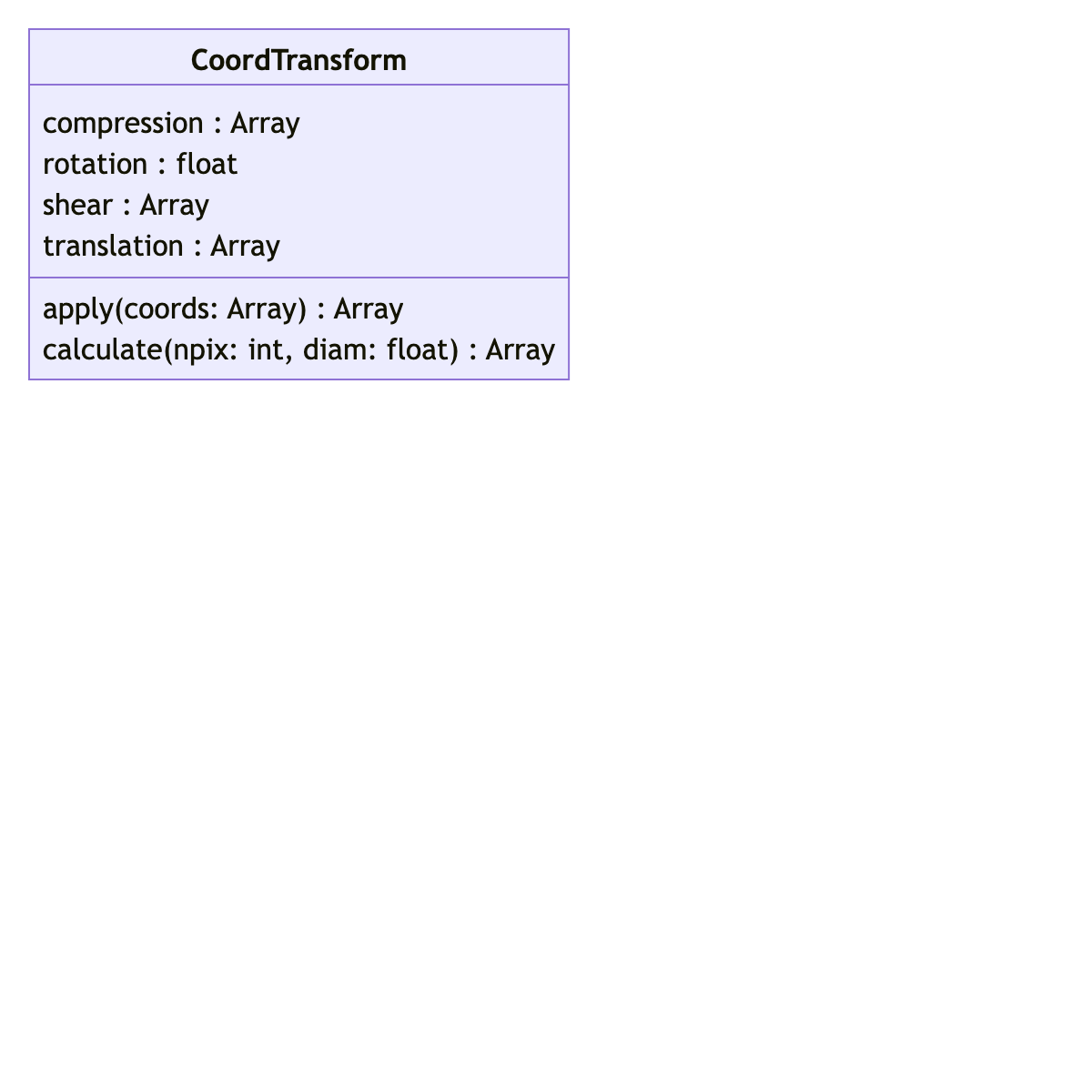
A simple class to handle coordinate transformations applied to dynamic aperture classes. Transformations are applied in the order: 1. Translation 2. Shear 3. Compression 4. Rotation

UML

UML

Attributes:

Name Type Description
translation Array

The (x, y) shift applied to the coords.

rotation float

The clockwise rotation applied to the coords.

compression Array

The (x, y) compression applied to the coords.

shear Array

The (x, y) shear applied to the coords.

Source code in dLux/transformations.py
 83
 84
 85
 86
 87
 88
 89
 90
 91
 92
 93
 94
 95
 96
 97
 98
 99
100
101
102
103
104
105
106
107
108
109
110
111
112
113
114
115
116
117
118
119
120
121
122
123
124
125
126
127
128
129
130
131
132
133
134
135
136
137
138
139
140
141
142
143
144
145
146
147
148
149
150
151
152
153
154
155
156
157
158
159
160
161
162
163
164
165
166
167
168
class CoordTransform(BaseCoordTransform):
    """
    A simple class to handle coordinate transformations applied to dynamic aperture
    classes. Transformations are applied in the order:
        1. Translation
        2. Shear
        3. Compression
        4. Rotation

    ??? abstract "UML"
        ![UML](../../assets/uml/CoordTransform.png)

    Attributes
    ----------
    translation: Array
        The (x, y) shift applied to the coords.
    rotation: float
        The clockwise rotation applied to the coords.
    compression: Array
        The (x, y) compression applied to the coords.
    shear: Array
        The (x, y) shear applied to the coords.
    """

    translation: Array
    rotation: float
    compression: Array
    shear: Array

    def __init__(
        self: CoordTransform,
        translation: Array = None,
        rotation: float = None,
        compression: Array = None,
        shear: Array = None,
    ):
        """
        Parameters
        ----------
        translation: Array
            The (x, y) shift applied to the coords.
        rotation: float, radians
            The clockwise rotation applied to the coords.
        compression: Array
            The (x, y) compression applied to the coords.
        shear: Array
            The (x, y) shear applied to the coords.
        """
        if translation is not None:
            self.translation = np.asarray(translation, dtype=float)
            if self.translation.shape != (2,):
                raise ValueError("translation must have shape (2,).")
        else:
            self.translation = None

        if rotation is not None:
            self.rotation = np.asarray(rotation, dtype=float)
            if self.rotation.shape != ():
                raise ValueError("rotation must have shape ().")
        else:
            self.rotation = None

        if compression is not None:
            self.compression = np.asarray(compression, dtype=float)
            if self.compression.shape != (2,):
                raise ValueError("compression must have shape (2,).")
        else:
            self.compression = None

        if shear is not None:
            self.shear = np.asarray(shear, dtype=float)
            if self.shear.shape != (2,):
                raise ValueError("shear must have shape (2,).")
        else:
            self.shear = None

    def __call__(self, coords):
        if self.translation is not None:
            coords = dlu.translate_coords(coords, self.translation)
        if self.shear is not None:
            coords = dlu.shear_coords(coords, self.shear)
        if self.compression is not None:
            coords = dlu.compress_coords(coords, self.compression)
        if self.rotation is not None:
            coords = dlu.rotate_coords(coords, self.rotation)
        return coords

__init__(translation=None, rotation=None, compression=None, shear=None) ¤

Parameters:

Name Type Description Default
translation Array

The (x, y) shift applied to the coords.

None
rotation float

The clockwise rotation applied to the coords.

None
compression Array

The (x, y) compression applied to the coords.

None
shear Array

The (x, y) shear applied to the coords.

None
Source code in dLux/transformations.py
112
113
114
115
116
117
118
119
120
121
122
123
124
125
126
127
128
129
130
131
132
133
134
135
136
137
138
139
140
141
142
143
144
145
146
147
148
149
150
151
152
153
154
155
156
157
def __init__(
    self: CoordTransform,
    translation: Array = None,
    rotation: float = None,
    compression: Array = None,
    shear: Array = None,
):
    """
    Parameters
    ----------
    translation: Array
        The (x, y) shift applied to the coords.
    rotation: float, radians
        The clockwise rotation applied to the coords.
    compression: Array
        The (x, y) compression applied to the coords.
    shear: Array
        The (x, y) shear applied to the coords.
    """
    if translation is not None:
        self.translation = np.asarray(translation, dtype=float)
        if self.translation.shape != (2,):
            raise ValueError("translation must have shape (2,).")
    else:
        self.translation = None

    if rotation is not None:
        self.rotation = np.asarray(rotation, dtype=float)
        if self.rotation.shape != ():
            raise ValueError("rotation must have shape ().")
    else:
        self.rotation = None

    if compression is not None:
        self.compression = np.asarray(compression, dtype=float)
        if self.compression.shape != (2,):
            raise ValueError("compression must have shape (2,).")
    else:
        self.compression = None

    if shear is not None:
        self.shear = np.asarray(shear, dtype=float)
        if self.shear.shape != (2,):
            raise ValueError("shear must have shape (2,).")
    else:
        self.shear = None
DistortedCoords

dLux.transformations.DistortedCoords ¤

Bases: BaseCoordTransform

A class to handle coordinates distorted by a 2D polynomial distortion.

UML

UML

Attributes:

Name Type Description
powers Array

Powers of the polynomial distortion.

distortion Array

Distortion coefficients.

Source code in dLux/transformations.py
171
172
173
174
175
176
177
178
179
180
181
182
183
184
185
186
187
188
189
190
191
192
193
194
195
196
197
198
199
200
201
202
203
204
205
206
207
208
209
210
class DistortedCoords(BaseCoordTransform):
    """
    A class to handle coordinates distorted by a 2D polynomial distortion.

    ??? abstract "UML"
        ![UML](../../assets/uml/DistortedCoords.png)

    Attributes
    ----------
    powers : Array
        Powers of the polynomial distortion.
    distortion : Array
        Distortion coefficients.
    """

    powers: Array
    distortion: Array

    def __init__(
        self: DistortedCoords, order: int = 1, distortion: Array | None = None
    ):
        """
        Parameters
        ----------
        order : int
            Order of polynomial to use.
        distortion : Array | None
            Distortion coefficients, defaulting to 0.
        """
        self.powers = np.array(dlu.gen_powers(order + 1))[:, 1:]

        if distortion is None:
            distortion = np.zeros_like(self.powers)
        distortion = np.asarray(distortion, dtype=float)
        if distortion.shape != self.powers.shape:
            raise ValueError("distortion shape must match powers shape.")
        self.distortion = distortion

    def __call__(self, coords):
        return dlu.distort_coords(coords, self.distortion, self.powers)

__init__(order=1, distortion=None) ¤

Parameters:

Name Type Description Default
order int

Order of polynomial to use.

1
distortion Array | None

Distortion coefficients, defaulting to 0.

None
Source code in dLux/transformations.py
189
190
191
192
193
194
195
196
197
198
199
200
201
202
203
204
205
206
207
def __init__(
    self: DistortedCoords, order: int = 1, distortion: Array | None = None
):
    """
    Parameters
    ----------
    order : int
        Order of polynomial to use.
    distortion : Array | None
        Distortion coefficients, defaulting to 0.
    """
    self.powers = np.array(dlu.gen_powers(order + 1))[:, 1:]

    if distortion is None:
        distortion = np.zeros_like(self.powers)
    distortion = np.asarray(distortion, dtype=float)
    if distortion.shape != self.powers.shape:
        raise ValueError("distortion shape must match powers shape.")
    self.distortion = distortion